St. George El-Mozahem
Jump to a story
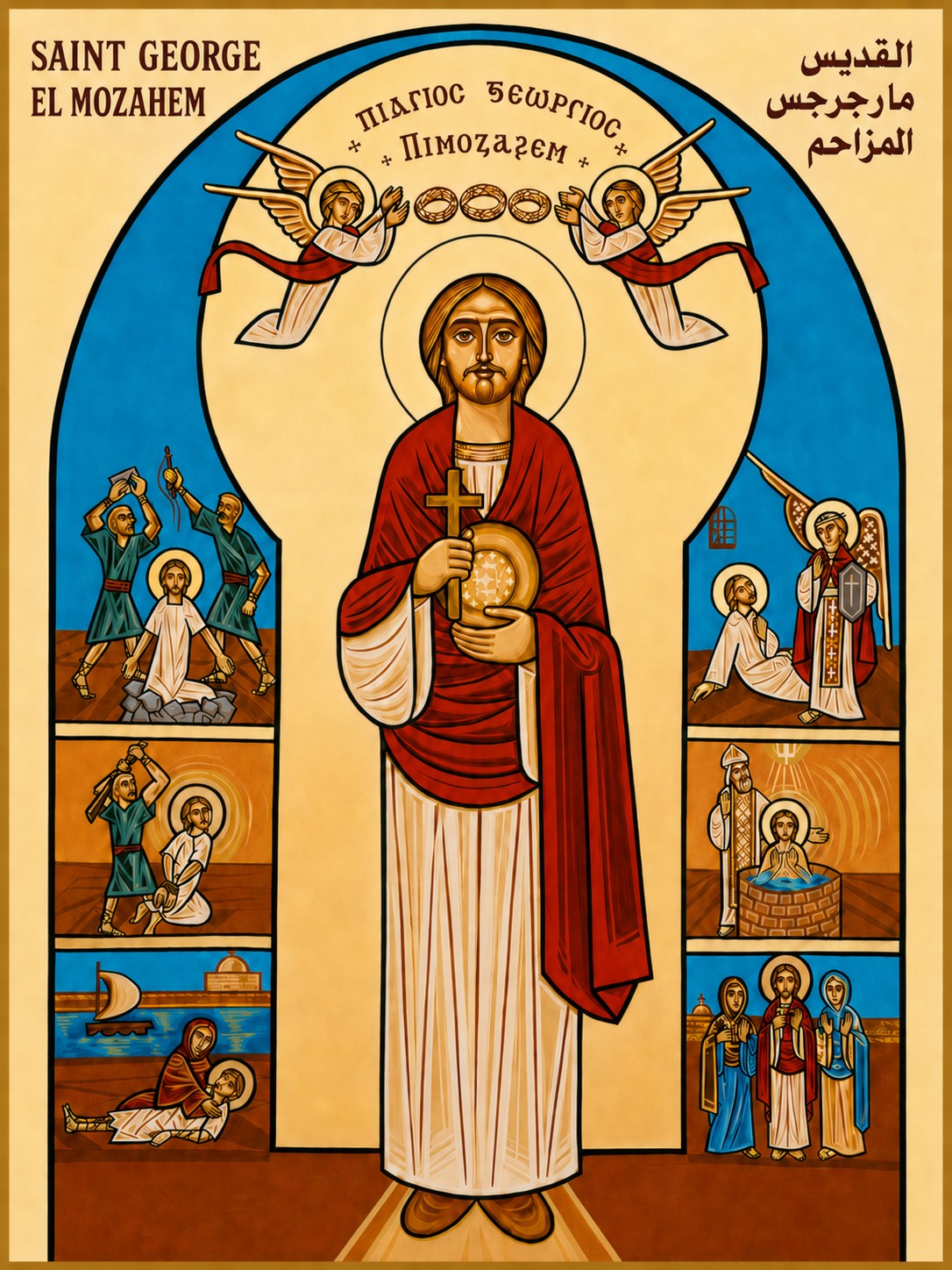
A Heart Captured by Christ
St. George El-Mozahem, also known in the Coptic tradition as Mar Girgis El-Mozahem, is one of the beloved martyrs of the Coptic Orthodox Church. His life reveals the mystery of God's grace: how a heart can be drawn to Christ through the beauty of the Church, strengthened through suffering, and crowned through faithful witness.
His story took place in Egypt during the Fatimid period. At that time, the Coptic people faced many pressures, yet the faith remained alive in the homes, churches, prayers, and liturgies of the people.
St. George El-Mozahem was born in the region of Talkha, near Dakahlia. His father was named Jumaa Al-Atawi, and his mother was a Christian widow named Mary. He was the third son among six boys and one sister. For the first twelve years of his life, he followed the religion of his father, but the Lord had already begun preparing his heart.
Drawn by the Holy Qurban
When El-Mozahem was about twelve years old, he noticed that his mother went to church every Sunday. A desire grew in him to follow her and see what she did there.
When she returned from church, he asked her to give him a piece of the Qurban, the blessed holy bread. When he tasted it, he found it sweet and beautiful. From that time, his heart became attached to the Church, and he began to desire the Christian faith.
This simple moment became the beginning of his journey to Christ. The grace of God entered quietly, not through argument, but through the mystery of the Church, the prayers of his mother, and the holy bread that awakened longing in his soul.
His Baptism
As he continued going to church, El-Mozahem desired to become a Christian. During the feast of the Virgin Mary, he came near to Anba Zacharias, Bishop of Damietta. Because the priests were afraid to baptize him publicly, he asked that the baptismal water not be poured away.
After the people left, he removed his clothes and immersed himself in the baptismal water three times in the name of the Holy Trinity. He believed that he had become a Christian, and at that time he was about eighteen years old.
Later, he received the holy Myron through a priest named Apamoun, and around the feast of Mar Girgis the Roman, he was given the Christian name Girgis, or George. From then on, he was known as Girgis El-Mozahem.
St. George and His Wife Seola
Afterward, St. George and Seola were joined together in a Christian marriage. Seola was the daughter of Hegumen Abanoub, the priest of the church of Bisat Al-Nasara in the Talkha region.
As a married couple in Christ, they encouraged each other to endure, abide in Christ, and remain faithful. Their relationship strengthened both of them to accept persecution and martyrdom, showing the holy pattern of Christian marriage.
His Confession Before the Governor
When God allowed his faith to be tested, El-Mozahem was brought before the governor. The governor asked him why he had left the religion of his fathers and become a Christian.
The saint answered boldly that he had become a Christian openly, and that he was neither a thief nor a murderer, but a worshiper of the Lord Jesus Christ. He told the governor to do whatever he wished, because threats did not frighten him.
The governor became angry and ordered him to be beaten until his blood flowed on the ground. His house was plundered, and he was sent away with servants who were ordered to imprison him without food or drink until he died.
But the Lord did not abandon him. As they were taking him away, a voice was heard commanding the servants to return him to the prince. When they returned, the governor was surprised, saying that he had sent no one. Then the angel of the Lord appeared in the form of one of the nobles of the city and obtained mercy for the saint, saving him from their hands.
The Suffering of Seola
A wicked man stirred up the authorities against the saint. When they came to arrest him, the Lord allowed him to escape for a time, but they seized his wife Seola.
They beat her severely, plundered what remained in her house, tied her to the tail of a horse, and dragged her through the town. No one was able to rescue her from their hands.
After some time, St. George secretly returned and sent for his wife. He comforted her because she had suffered greatly for his sake. He even offered to release her from their marriage if she wished, so that she would not continue suffering because of him.
But Seola answered with faithfulness, saying that she would not separate from him all her life, even if her blood were shed because of him, because she suffered for the name of Christ. Her words comforted his heart, and he thanked God for the strength of her faith.
Wandering, Hiding, and Serving God
St. George moved from place to place, seeking where the Lord would guide him. He lived for a time in Saft Al-Qudur, working in an oil press. There he remained constant in worship day and night.
But the enemy stirred up people against him again. A crowd gathered with swords and weapons. They tied a rope around his neck, dragged him through the streets, and accused him falsely. One man struck him on the head until he fell unconscious.
Later, he lived in Tanta for about three years. During that time, he became very sick, but he did not grumble. His wife encouraged him and reminded him how many times the Lord Jesus had saved him from the temptations and attacks of the devil. He continued praising God night and day.
A Life of Prayer and Metanoias
St. George later went with his wife to Bisat Al-Nasara, where her father lived. There he served the Lord with all his heart, increasing in fasting, prayer, and worship.
Every night, he made five hundred metanoias, offering his body and soul before God in repentance and love. He began to think about going to the Monastery of Saint Macarius to become a monk.
But the Lord revealed another path for him. In a vision, he saw the glory of the Lord and heard a voice calling him to strengthen himself for martyrdom. He was told that he had been counted worthy to be among the holy martyrs and to receive the heavenly crown.
The Beginning of His Final Trial
Men attacked his house but did not find him, so they seized his blessed wife and beat her because she said she did not know where he was.
When they found St. George, they threw him into prison. Many gathered against him, beating him without mercy with sharp instruments, dry sticks, green palm branches, and stones until his bones were broken.
Yet the saint remained patient. He did not stop mentioning the name of the Lord Christ, even while his hands were bound behind his back.
His Refusal to Deny Christ
The governor brought him forward and questioned him. A wicked man tried to tempt him with worldly honor, promising him authority and status if he would deny Christ.
St. George answered that even if he were given all the king possessed, he would not deny the name of his good Savior, lest he become like Judas Iscariot the traitor.
"And do not fear those who kill the body but cannot kill the soul."
Archangel Michael Comforts Him
After severe torture, St. George was imprisoned and his feet were bound in heavy wood. At midnight, Archangel Michael appeared to him, blessed him, comforted him, loosed his bonds, and touched him with his wings. The saint was healed from all his wounds.
This miracle was witnessed by a Christian monk named Mina from the Monastery of Saint Macarius, who was imprisoned with him and became the writer of this biography.
Seola Visits Him in Prison
On the third day of his imprisonment, after he had eaten nothing, his wife Seola entered to visit him. She found him healed from his wounds, and she rejoiced and glorified God.
Those who hated him continued to torture him repeatedly, thinking he had died, only to return and find him alive again. This continued from the eleventh to the eighteenth of Baona, in the year 695 of the Martyrs, corresponding to 979 A.D.
His Martyrdom
A message came from the Sultan ordering that Girgis and his matter be left alone. The messenger even said that two people in Cairo had embraced Christianity and that the Sultan had left them alone.
But the anger of the people was so intense that they ignored the Sultan's command.
On the morning of Thursday, 19 Baona, they brought St. George out of prison and gave him a choice: deny Christ or die. Their threat was useless. He declared that he was ready to accept not only death, but torment also, for the sake of Christ.
St. George El-Mozahem received the crown of martyrdom on 19 Baona, 695 A.M. — 979 A.D.
They led him outside the town to the shore. There, they struck him on the head until it was crushed, cut his body, and threw the parts into the sea. Thus, St. George El-Mozahem received the crown of martyrdom.
The Recovery of His Relics
On the same day, a deacon was walking near the shore and heard a voice calling him to wait in the name of Christ until the waves brought him a part of the body of the martyr Mar Girgis El-Mozahem.
The deacon waited, and the waves brought part of the saint's relics. He took them home and told his mother what he had heard. His mother wrapped the relics in a white cloth and gave them to the righteous Seola.
Seola placed the relics in her father's house for a time, and later they were placed in the church. Through them, many signs and wonders occurred.
What His Life Teaches Us
Christ Can Capture the Heart Quietly
His journey began not with force, but with holy longing: seeing his mother go to church, tasting the blessed Qurban, and desiring the life of Christ.
The Liturgy Is a Door to Heaven
The beauty of the Church's worship opened his heart to the mystery of Christ. His story reminds us that Orthodox worship is not performance; it is the life of heaven touching the earth.
St. George and Seola in Christian Marriage
As husband and wife in Christ, they strengthened one another to endure persecution, abide in the Lord, and walk together toward martyrdom. Their marriage shows the calling of Christian couples to support one another in faith and holiness.
Courage Comes from Love
St. George did not endure suffering because he loved pain. He endured because he loved Christ more than comfort, safety, honor, and life itself.
Heaven Strengthens the Faithful
The appearance of Archangel Michael shows that the martyrs are never abandoned. Christ strengthens His servants in ways seen and unseen.
A Prayer Through the Intercession of St. George El-Mozahem
O Lord Jesus Christ, who strengthened Your martyr St. George El-Mozahem to confess Your holy name, grant us courage, purity of heart, and steadfast faith. Through his prayers and the prayers of his faithful wife Seola, help us to love You above all things and remain faithful until the end. Amen.
This page is prepared for future interactive artwork. Each numbered section corresponds to a scene in the life of St. George El-Mozahem. Artwork integration coming soon.